On small volumes, manual labor, although not very effective, still somehow holds. But when it comes to hundreds or thousands of units of products every day, systemic problems begin.
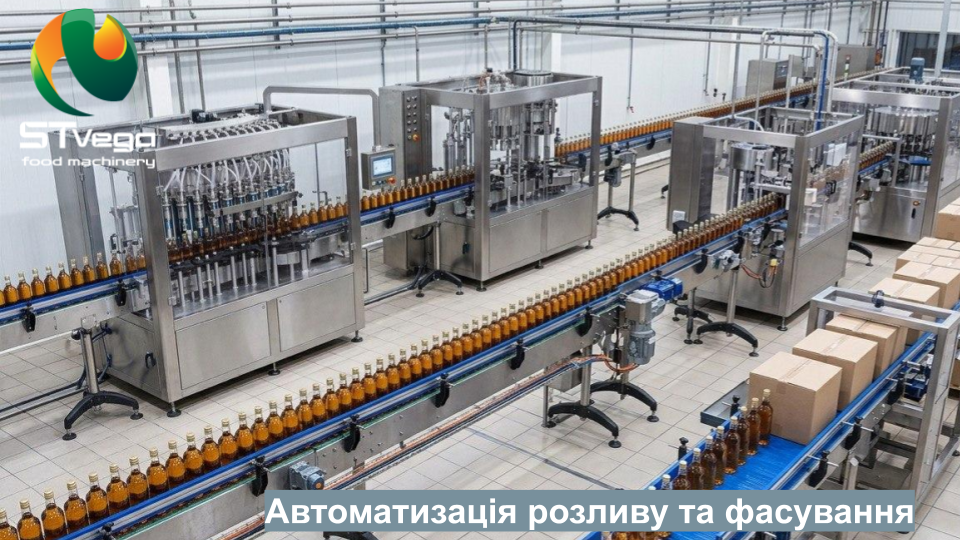
First, speed. A person physically cannot work stably for 8-10 hours without losing pace.
Secondly, accuracy. Every extra gram of product is a loss that accumulates in large amounts.
And thirdly, quality control. With manual bottling, it is difficult to ensure the same result in each unit of production.
As a result, the business runs into a “ceiling” that cannot be broken without changes in production.
When the automation of food production and packaging appears, the picture changes dramatically.
First of all – speed. The line works smoothly, without pauses and “human” vibrations. What used to take a shift is done in a few hours.
Next is stability. Each bottle or jar is filled in the same way. No “by eye”, no deviations. This is important not only for the economy, but also for customer trust.
And separately, it is worth mentioning the costs. At first glance, it seems that automation is expensive. But if you calculate the losses from overflow, defects, downtime and payment for manual labor, the numbers quickly become different.
Automation doesn’t just save money – it makes costs predictable.
Interestingly, the automation of liquid product bottling has long gone beyond large factories.
Today it is actively used:
And each of these areas has its own nuances. Water is speed. Oil – cost control. Sauces – work with thick textures. But the principle is the same: without automation, it is difficult to maintain quality and volume at the same time.
There is no one-size-fits-all answer here. It all depends on the stage of business development.
Partial bottling automation is when individual processes are already mechanized. For example, there is a dispenser or a semi-automatic machine, but some of the work is still done manually. This is a good option for start-ups or small productions.
Full automation is another story. A full-fledged line where the product goes all the way: from feeding to capping and then to packaging. Minimum human involvement, maximum control.
And this is where the key point comes in.
It is possible to optimize manual labor for a long time. Hire more people, change schedules, introduce controls. But it gives a short effect.
Sooner or later, any manufacturer runs into restrictions.
And at this moment it becomes clear: in order to grow further, you need not just optimization, but a systematic change in the process. That is, the transition to automated solutions.
That is why the automation of food production and packaging is not a trend and not a “fashion story”. This is a logical stage in the development of any business that wants to work stably and scale without chaos.
When it comes to packaging, many people imagine one machine that “does everything by itself”. In practice, everything is a little more complicated.
Bottling and packaging is not a separate unit, but a whole system, where each element is responsible for its area of work. And if at least one of them “sags”, the entire line suffers.
It all starts with the dosage. This is where precision is formed, and with it, the economics of production.
Dispensers for liquid and thick products are selected depending on the consistency:
The most common mistake is to take a “universal” dispenser. In practice, it either overflows or works unstably.
After dosing, the process of filling the container itself takes place. And here different types of cars come into play.
The most common:
Each type has its own logic of work. And what is interesting is that the same line for water and, say, for sauce can differ dramatically.
Tara is another important factor that is often underestimated.
Equipment for bottling into bottles and cans takes into account:
For example, working with glass containers requires a more delicate approach. And PET bottles, on the contrary, allow you to work faster, but have their own nuances in the stability of the shape.
In this case, it is important that the system is customized for a specific product and packaging, and not “somehow universally”.
After bottling, the process does not end. In fact, it is only gaining momentum.
Full-fledged industrial equipment for packaging products includes:
And it is the conveyors that often play a key role. They set the rhythm for the entire system. If the speed is out of sync, traffic jams or downtime occur.
This is where the main understanding comes in.
Bottling is a chain:
Product feeding → dosing → filling → capping → labeling → shipment.
And if you look at it as a set of individual cars, problems arise:
Something does not fit, something works slower, somewhere there are losses.
When it is designed as a system from the very beginning, everything works differently.
Each element is selected for the other. The speed is matched. Costs are controlled.
That is why, when choosing equipment, it is important to look not at a separate dispenser or machine, but at the entire logic of the process as a whole. Otherwise, instead of automation, you can simply get an expensive set of equipment that does not give the desired result.
When they say “a bottling line is needed”, they often do not fully understand what exactly is meant.
This is not one machine or even two. This is a related process, where each stage logically continues the previous one. And if you look at it from the side, it becomes obvious: the line for bottling and packaging liquid products is actually the heart of production.
This is where speed, stability and, last but not least, profit are formed.
In its basic form, an automatic filling line for liquids includes several key components. And each of them solves a specific problem.
The typical configuration looks like this:
Sounds simple. But in practice, it is in the correct combination of these elements that the result lies.
STvega, for example, often does not just “sell equipment”, but assembles solutions for a specific product and production. And this is critical. Because the water line and the sauce line are two different stories.
To understand the logic, it is enough to go through the entire cycle.
First – the supply of the product. Raw materials enter the system through containers or pipelines. It is important that the pressure and supply are stable.
Next – dosage. Here the exact volume of each unit is determined. It is at this stage that the business either loses money, or, conversely, begins to save it.
After that – bottling. The product falls into bottles, cans or other containers. In this case, it is important not only quickly, but also carefully – without foam, without splashing.
The next step is capping. The container is hermetically sealed. The shelf life and quality of the product depend on this.
Then – labeling. Label, date, information for the consumer.
And the final is the movement of products to the warehouse or packaging.
It looks like a conveyor. But behind this is a well-tuned system, where all elements work in the same rhythm.
One of the most frequently asked questions is: where to start?
Semi-automatic lines are a compromise. Some of the processes are automated, but the participation of the operator is still required. For example, container feeding or capping control.
This is a good option if:
But there is a nuance. The semi-automatic always has a speed limit.
A fully automatic filling line for liquids works differently. Here human participation is minimal. The whole process is continuous: from feeding to finished products.
The advantages are obvious:
These are the solutions STvega usually offers to businesses that are already reaching stable volumes or planning to grow.
There are several signals that should not be ignored.
For example:
This means that manual or semi-automatic solutions are no longer extracted.
In practice, many manufacturers follow the same path. First – manual bottling. Then semi-automatic. And at some point they abruptly switch to a full line.
For example, a sauce maker might start with a simple dispenser. But when the volumes grow 3-5 times, it simply cannot cope without an automatic line. Delays, complaints, losses begin.
After establishing a full-fledged line, the situation changes in just a few weeks. Production is leveled off, bottlenecks disappear, and business begins to operate predictably.
And here is the main idea.
And if you approach it correctly – taking into account the product, volumes and development plans – it begins to pay off much faster than most manufacturers expect.
In practice, we at STvega often encounter the same situation. The client comes with a request for packaging, and at first it seems that the task is standard. But as soon as it comes to sauces, creams or pastes, it becomes clear that a completely different approach is needed here.
And this is normal. Thick products always require more precise and thoughtful solutions.
In our work, we immediately pay attention to the consistency of the product. Because it determines everything: from the type of dispenser to the configuration of the line.
Thick foods:
And if simple solutions are suitable for water or oil, then here they no longer work.
That is why we always select equipment for packaging pasty products individually. No templates.
In most cases, for such tasks, we use:
When it comes to filling machines for filling sauces and creams, the key is not just the type of equipment, but its customization for a specific product.
We do not select “by catalog”. We look at how the product behaves, and we form a solution for this.
Most clients come to us after the first difficulties.
Typical situations:
At first glance, these are trifles. But in terms of volumes, these are direct financial losses and quality problems.
We always explain: the problem is not with the product. The problem is the wrong equipment.
At STvega, we do not work “in theory”. One of the key stages is testing.
We are watching:
And after that, we select dispensers for liquid and thick products that will give a stable result.
Sometimes a small adjustment is enough. And sometimes a completely different solution is required. And this is normal.
Most often, customers ask: “Is it possible to do something universal for both one product and another?”
You can. But we usually don’t recommend it.
In the case of thick foods, versatility almost always means compromise. And the compromise in production is either losses or unstable quality.
Therefore, at STvega, we always start from the problem, not from the ready-made solution.
And to put it briefly.
They determine whether the line will work stably every day or whether it will constantly require intervention.
We see this in practice. And that is why we approach the selection of equipment as accurately as possible.
When customers contact us at STvega, the question of price sounds almost immediately. But we always explain one simple thing: a packaging line is not one product with a price list, but a solution for the problem.
And that is why the spread in cost can be very different.
In real projects, we start from several basic parameters:
In the packaging and packaging category, STvega offers different types of equipment: dispensers, filling machines, packaging solutions, capping and labeling (stvega.net)
And it is the combination of these elements that forms the final budget.
To make it clearer, here are the specific solutions we use in our projects:
| Equipment | STvega | What is it used for |
| Dosage | STvega Liquid Filling Machine | Precise filling of containers with liquid products |
| Bottling and packaging | STvega LPack H70 | Packing liquid and pasty products in bags |
| Closure | STvega Automatic Corking Machine | Automatic closure of bottles and cans |
| Trays | STvega Tray Sealer L331 | Sealing ready-made trays |
| Containers | STvega Tray Cap | Closing food containers |
| Labeling | STvega Labeling Machine | Labeling |
| Additionally | STvega Tray Sleeve Applicator L50 | Wrapping trays with a cardboard shell |
| Packaging | STvega clippers (various models) | Closing bags, vegetables, products |
This is not “the whole list”, but it shows well the main thing: the line consists of modules. And they can be combined for a specific product and budget.
We usually offer three scenarios.
Start / small production
Minimal investment, but also limited performance.
Intermediate level
This is already a stable system without constant manual work.
Full automation
It is these solutions that we at STvega most often implement for scaling.
We honestly tell customers: most of the problems arise not from the equipment, but from the wrong choice.
What we see most often:
And as a result, double costs.
The short answer is yes, but without fanaticism.
We at STvega usually recommend:
Because the equipment should work, not “stand in reserve”.
This is perhaps the main idea of the entire article.
We always build logic like this:
Product → process → equipment
And not vice versa.
Because:
That is why we at STvega test, select and configure equipment for a specific production.
And to sum up without unnecessary pathos.
The right selection of equipment is not about saving at the start. It’s about stability every day.
Fewer losses.
Less handmade.
Fewer “surprises” in production.
And this is what gives the business growth without chaos as a result.
In short, because they don’t sell “just equipment” here. At STvega, we build solutions for production. And this is felt not in the presentation, but already in the work of the line.
Most suppliers work simply: there is a catalog, there is a price, choose.
We have a different approach.
We:
Therefore, the result is not a “set of equipment”, but a working system.
STvega works with both individual machines and complex solutions.
This means that you can:
And all this within the framework of one partner.
The company is engaged in the selection, sale and configuration of equipment – from individual modules to complete production lines
Real quality control and service
We don’t just supply equipment.
What the client gets:
And this is important. Because equipment is not a purchase “once and for all”. This is a working tool that should work stably every day.
Each production has its own logic.
Therefore, in STvega:
You can assemble a compact line for a small production or a large-scale system for a large business. And it will be a different approach, not “one solution for all”
Showroom and equipment testing
One of the key points that is often underestimated.
We have the opportunity to:
And this removes most of the risks even before buying.
Because in practice, even similar products can behave differently.
And one more point that speaks for itself.
STvega’s clients include:
These are companies where equipment errors are very expensive. And the fact that they work with STvega is an indicator of the level of solutions
At the start, it may seem that you can find cheaper.
But in reality, the winner is the one who:
And this is where the difference between “buy a car” and “start production” becomes visible.
To put it simply.
STvega is when the equipment starts working for the business, rather than creating new problems.
And this is what gives the greatest savings in the long run – money, time, and nerves.
7. Why is it worth working with STvega?
Because we don’t just sell equipment. We select solutions for the business, test the product, help with the launch, and accompany the client after the purchase. Plus – real experience of working with large manufacturers, where stability and results are important, not experiments.
