My name is Andrew. I am the director of STvega and have been working with food industrial equipment for butcher shops and industries for many years.
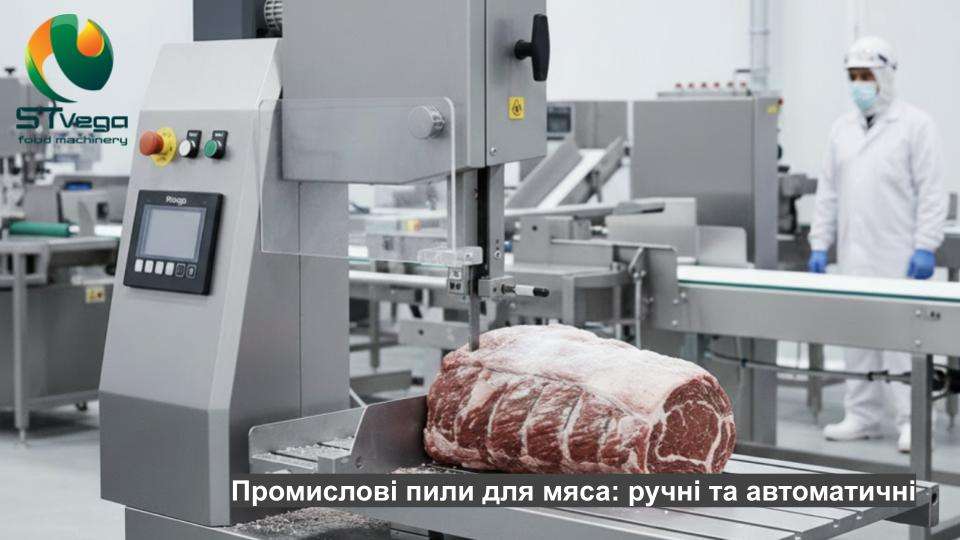
During this time, I have seen dozens of identical stories. An entrepreneur buys a cheap band saw for meat. After a few weeks, it begins to heat up, after another month the gearbox or motor breaks down. There are no spare parts. Production is worthwhile. Frozen meat is thawed. Losses are estimated at tens of thousands of hryvnias.
And then people understand a simple thing. A cheap industrial meat saw is not a savings. This is a risk.
In this article, I will honestly analyze:
This is a material for owners of butcher shops, sausage industries, processing enterprises and technologists who want not just to cut meat, but to build a stable business.
A hand saw for meat is the most popular option to start. It is compact, cheaper, takes up a minimum of space in the workshop.
The principle of operation is simple. The operator himself feeds the meat to the tape fabric. Speed, evenness of cutting and safety depend on it.
A handheld band saw for meat will be appropriate if:
For small production, this is a normal start.
Sellers are usually silent about them.
If you process more than 300 kg of meat per day, the manual model begins to slow down business development.
And here comes the question of automation.
An automatic meat band saw works differently. The operator only downloads the product. Further, feeding, fixing, slicing occur automatically.
A person controls the process, and does not perform heavy physical work.
An automatic meat saw is necessary if:
Yes, the price is higher. But you need to count not the costs, but the payback.
A hand saw gives an average of 300-400 kg per shift.
An automatic model like STvega Automatic Msaw – 500-800 kg in comfortable mode without overloading.
The price difference can be 100-150 thousand hryvnias. But with volumes of 500 kg per day, this difference returns in 4-6 months due to:
After that, an automatic saw for meat production begins to work in the black.
When you choose an industrial saw for meat, look not at the shine, but at the metal.
High-quality food equipment is made of AISI 304 or 316 stainless steel. She:
The thickness of the metal should be 2-3 mm. A thin sheet is quickly deformed, vibration appears, skew of the canvas.
The ribbon fabric is selected for tasks:
The canvas is a consumable. It changes regularly. And it is important that the supplier has them in stock.
Many people underestimate accuracy.
Let’s say you cut steaks of 200 g. Manual slicing error is 5-10 g. For a year – a ton of losses.
The automatic saw gives an accuracy of up to ±0.1 mm. These are weight control, stable cost and projected profits.
This is especially critical for:
Precision in meat production is not aesthetics. This is financial discipline.
Any industrial equipment needs maintenance sooner or later.
The question is not whether the saw will break. The question is what will happen next.
Before buying an industrial meat saw, be sure to ask:
One day of downtime of average production can cost 20-30 thousand hryvnias. Two weeks of waiting for a spare part is already hundreds of thousands of losses.
That is why the service is more important than the original price.
Hand band saw for meat
Automatic meat saw
If the business is growing, automation is a logical step.
An industrial meat saw is not just equipment. This is the point on which the rhythm of the entire production depends.
Cheap solutions often become expensive adventures.
A high-quality band saw made of stainless steel, with the right blade and service support works for years and is profitable.
At STvega, we test equipment in real production. We know which nodes fail first. We keep spare parts. We train operators. And we don’t disappear after the sale.
If you are planning to buy a saw for a butcher shop or want to switch from a manual model to an automatic one, it is better to calculate the economy once than to count the losses later.
Sincerely,
Andrew
Director of STvega
