When customers contact us at STvega , the question usually sounds simple: “Which packaging to choose?”.
But after a few minutes of conversation, it becomes clear that everything is a little more complicated.
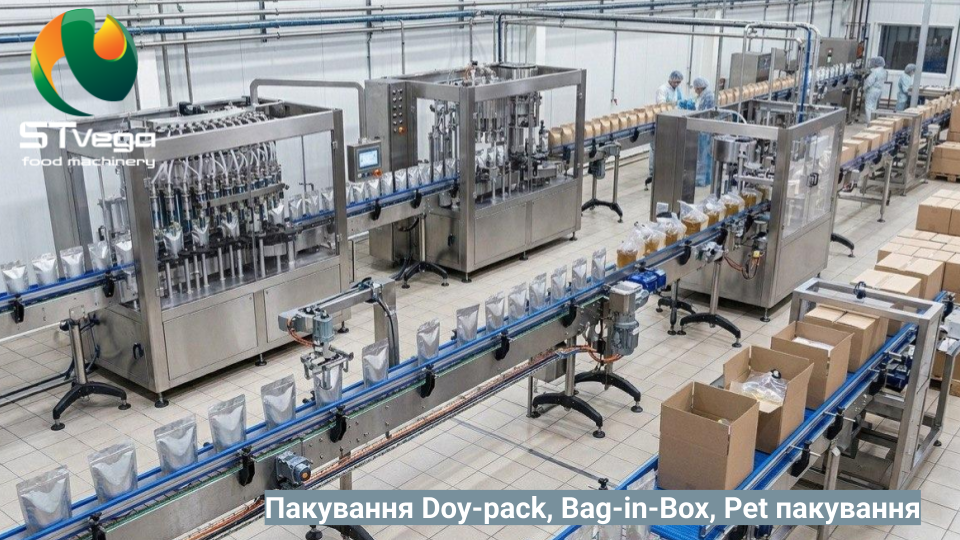
Because the types of food packaging today are not 2-3 options. These are dozens of formats, each with its own nuances, limitations and, frankly, pitfalls.
And if you make a mistake at the start, it then “comes out” in production, logistics and even in sales.
To put it simply, the entire market can be divided into three broad categories:
These include:
This packaging is loved for its compactness and modern look. It sells the product well on the shelf, but requires the right equipment and sealing technology.
Most often it is:
Rigid packagingI wins in transportation and storage. But it takes up more space and is often more expensive in logistics.
A classic example is bag-in-box:
This format is actively used for juices, wine, syrups. It allows you to store the product longer after opening and is convenient for large volumes.
In practice, everything looks even simpler.
At STvega, we regularly see the same story: the same product can be packaged in three different formats – and get three completely different sales and cost results.
And here is the main thing.
There is no “better” packaging per se. There is packaging that is suitable or not suitable for a specific task.
It all depends on:
We always tell customers one thing:
First, the product and business model – then packaging, and only after that the equipment is selected.
Because if you do the opposite, you will either have to overpay or redo everything from scratch.
And this is exactly the moment where the right decision at the start saves a lot of money later.
In short, doy pack pack what is it?
It is a flexible bag with a special bottom that allows it to stand upright on the shelf. That is why it is also called a “standing bag”.
And now it’s easier. You have definitely seen it in the store: sauces, ketchup, baby puree, snacks, even ready meals. Lightweight packaging that does not fall off and looks neat.
What is doy pack packaging in terms of production?
This is a multilayer package (often made of laminated materials) that:
It looks simple, but behind this “simplicity” there is a fairly accurate technology.
Especially when it comes to liquid or hot foods.
At STvega, we often encounter a situation when the client underestimates the stage of sealing and the stability of the package. And then leaks or transportation problems begin.
Doy-pack is a fairly versatile format, but there are some “favorite” categories.
It is most often used for:
Why here? Because the product “fits” well in flexible packaging and does not require a rigid shape.
There is a reason why this format is literally everywhere now.
First, saving space.
Both in the warehouse, and during transportation, and on the shelf.
Secondly, convenience for the client.
Opened, used, closed. No unnecessary movements.
Thirdly, a modern look.
And here is an important point – the doy-pack really “sells”.
It looks lighter, more modern and often outperforms classic cans or bottles on the shelf.
But not everything is so perfect.
There are times when doy-pack is not the best choice:
And one more nuance that often pops up after launch:
Not every product behaves stably in flexible packaging.
To be honest, without marketing – doy-pack is chosen when you need to combine three things:
Convenience
savings
and appearance
This is the format that works well in retail and “catches” the buyer at first sight.
We at STvega often refer to it simply:
packaging that not only preserves the product, but also helps sell it.
There are two formats that are often confused with each other. Especially at the start of production.
On the one hand – bag-in-box, on the other – PET. And both are actively used for liquids.
But they work in completely different ways.
So, bag in box packaging what is it?
This is a combined system:
That is, the product is actually stored in a bag, and the box acts as protection and transportation.
What is bag in box packaging in practice?
It is a solution that allows:
It is most often used for:
At STvega, we often recommend this format to those who work with larger volumes or focus on HoReCa.
Now a different approach.
PET packaging what is it?
This is a rigid plastic container that everyone knows as ordinary water or drink bottles.
What is PET beverage packaging?
It is a one-stop solution for mass production:
Why is it so popular?
Because these are:
And, importantly, under PET there are already a huge number of ready-made solutions for bottling, capping and transportation.
If you discard the theory, the difference becomes obvious when you look at real problems.
Storage
Transportation
Ease of use
This is exactly the moment where universal advice does not work.
If you need:
Then you should look towards the bag-in-box.
If the bet is on:
PET would be a more logical choice.
We at STvega usually take a simpler approach:
We do not select packaging “in general”, but look at the product, sales channel and volumes.
And already for this, all logic is built – from containers to equipment.
This is where the fun begins.
Because the question of doy pack or bag in box which is better is actually wrong in itself.
There is no “better” option. There is one that works for a specific product and business.
And if you look at the practice that we see every day at STvega, the difference becomes apparent very quickly.
Before choosing a format, you need to understand one thing:
The packaging features of liquid products greatly affect everything from production to sales.
Key factors:
And we start from this.
In short:
But this is too general. Let’s look at practice.
Here the question often arises: which packaging for juices and beverages to choose?
Why is that?
The juice, after opening, quickly comes into contact with air. And bag-in-box really wins here – the product is stored longer.
Everything is a little tougher here.
Doy-pack is used, but not always. Especially if the product is “demanding”.
This is where the doy-pack is fully revealed.
Why?
Because usability is critical here. And flexible packaging wins.
There are almost no options here.
Doy-pack in this category is rather an exception.
Simplified to logic:
And one more point that is often underestimated.
Which packaging is best for liquids is not only about containers.
It’s also about the equipment that works with it.
Because the same product in different formats requires completely different bottling, sealing and control lines.
That is why we at STvega usually do not start with the question “which bag or bottle”.
We start with the product and the task.
And only then we select a solution for this that will not create problems in production in six months.
To be honest, most manufacturing mistakes don’t start with hardware.
They start with the wrong choice of packaging.
And the question of how to choose packaging for a product is not about “like / dislike”.
It’s about numbers, logic and a little experience.
At STvega, we almost always see the same situation: people first look at the packaging, and only then think about how to produce it.
And this is where the extra costs begin.
There are several factors that decide everything. Without exaggeration.
And here is a little practice.
Not to be abstract, here is a simple selection logic:
| Situation / task | What packaging is | What to consider for equipment |
| Sauces, purees, thick foods | Doy-pack | Thick mass dispensers, high-quality sealing |
| Juices, syrups in large volumes | Bag-in-box | Leak control bottling lines |
| Water, mass-market | PET | High Productivity and Stable Filling Line |
| HoReCa, large packages | Bag-in-box | Convenience of dosage and storage |
| Product “on the shelf”, design | Doy-pack | Package stability and seam quality |
And here is the main thing.
We do not select “packaging from the catalog”.
We look at the task of business.
Often this means that the solution is different from what the client originally planned.
And this is normal.
Moreover, we have the opportunity to test the options, see how the product behaves, and understand if there will be any problems after a few months of work.
Because one correct action at the start is usually cheaper than processing the entire production later.
There is one thing that is difficult to convey in a catalog or presentation.
How the equipment behaves in real operation.
That is why at STvega we focused not only on sales, but on the ability to see everything with your own eyes even before buying.
Yes, you can just come to us.
STvega has a warehouse showroom where:
And this, frankly, often changes the decision.
Because it’s one thing to look at the specs.
And it’s quite another to see how your sauce, juice or puree is really packaged, sealed and looks at the output.
Sometimes, after such a test, customers change both the packaging format and the production approach itself. And this is a normal story.
If it is not possible to come, it is also not a problem.
We actively show the equipment in operation:
Without “gloss” and editing for a perfect picture.
You can clearly see there:
Sometimes it is even more useful than a consultation. Because you immediately understand whether such a solution is right for you.
The problem with most solutions on the market is simple:
Equipment is purchased “blindly”.
As a result:
We at STvega try to avoid this.
Therefore, we make it possible to:
And only after that make a decision.
Because, as practice shows, one visit to the showroom or even 10 minutes of video can save months of alterations and very tangible money.
7. How can STvega help when choosing packaging?
STvega helps to choose not only packaging, but a complete solution for the product: from testing in the showroom to line selection. This allows you to avoid mistakes and start production without unnecessary costs.
