Not so long ago, the grill was the story of the season. Summer, an open terrace, smoke that can be heard a block away, and the same kebab for which people stand in line. It seemed that with the first cold weather, all this automatically disappears.
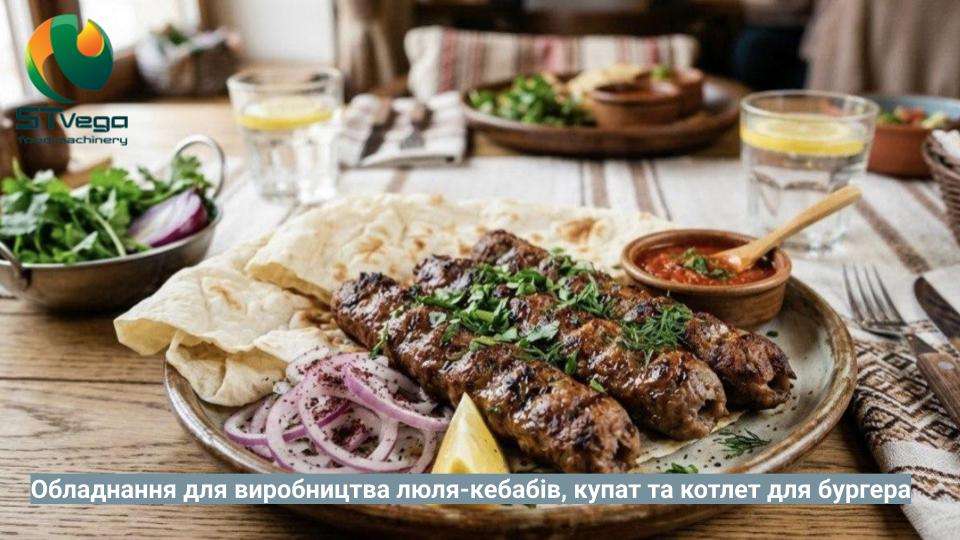
But the market took a different path.
Today, kupaty, juicy burger patties and the same kebab do not disappear anywhere even in winter. They are ordered in delivery, taken with them, added to the menu of establishments that have not worked with the grill at all before. People are just used to this taste. And no one wants to give it up because of the weather.
Gradually, seasonality was erased. Not abruptly, without loud statements – but the fact remains. Grilling has ceased to be a “summer theme” and has become a stable destination that can generate income all year round.
And here another question arises.
If there is constant demand, is the business ready to withstand it? Because cooking several dozen products by hand is one story. And consistently giving out hundreds or thousands of servings every day is completely different.
It is at this point that not only the recipe becomes important, but also how the production is built. And without normal equipment, it is already difficult to talk about stability, speed and the same quality of the product.
If you look closely, the changes didn’t happen in the kitchen – they happened in the way people behave. Previously, a trip to the grill was an event: good weather, company, mood. Now everything is much simpler: open the application, choose a burger or kebab, and in half an hour it is at your home. No special occasion, no waiting for the season.
Delivery has been a radical game-changer. What used to be cooked only on the grill on the street is now successfully prepared in small kitchens, workshops and even supermarkets. Cutlets and kebabs began to take on a life of their own – as semi-finished products or ready meals.
Another factor is the format of institutions. There are many small points where there is no large kitchen and speed and stability are important. There, no one will sculpt cutlets by hand: you need a product with the same shape, weight and appearance. The grill ceases to be about the atmosphere and becomes about consistency.
The demand is now daily and does not depend on the time of year. In winter, it can even grow: people are more likely to order delivery and are looking for something satisfying and understandable. A burger or kebab perfectly covers this need.
As a result, the market works constantly, and does not “live” from season to season. Those who adapt to the new reality win – both in the menu and in the organization of production.
If you look at the menus of various establishments, the picture is quite obvious. There are several positions that hold up steadily and do not go out of style. These are kebabs, kupaty and classic burger patties.
At first glance, it seems that these are similar things. Minced meat, spices, mold. But in practice, the difference is noticeable.
Lula kebab is about texture and density. It should stay on the skewer, not fall apart and at the same time remain juicy. The correct structure of the minced meat and a stable shape are important here. If the product looks different every time, it is immediately noticeable.
Bathing is another story. Here a shell is added, a different consistency and completely different filling requirements. It is important that the minced meat is evenly distributed, without voids and distortions. Otherwise, the output of the product will be unstable.
With burger patties, everything seems to be easier. But only at first glance. They must be the same in weight, thickness and diameter. Otherwise, the kitchen begins to “float”: the cooking time is different, the appearance is different, the taste may also differ.
And here one common problem becomes visible.
When the volume is small, you can still somehow keep the quality manually. But as soon as a steady flow of orders begins, the difference between the products becomes noticeable. And with it there are losses, returns, and dissatisfied customers.
That is why these three products are increasingly being transferred to production using equipment today. Not because it is “fashionable”, but because otherwise it is difficult to keep the same result every day.
When it comes to real volumes, everything quickly falls into place. Manual work begins to slow down the process, and the quality “floats” from batch to batch. This is where the need for a normal production solution appears, and not improvisation.
It all starts with the base – the preparation of minced meat. Minced meat and allow you to get a stable structure, without lumps and twists. This is the foundation without which there is simply no point in moving on. If the minced meat is different every time, no amount of shaping will save the day.
Next comes the most interesting thing – the formation of the product.
For burger cutlets, molders are used, which set the exact weight and shape. Each cutlet looks the same, cooks the same and does not cause problems in the kitchen. For kebabs, special nozzles or separate solutions are used that allow you to get a dense and even product without hand modeling. Syringes and fillers work with the cups, which ensure uniform filling of the shell.
And this is where the difference between “just equipment” and a thoughtful approach begins.
STvega is just closing this moment. They do not just sell individual cars, but select solutions for a specific task. Someone needs a compact version for a small workshop, while someone builds production with larger volumes and completely different requirements.
Another important nuance is the ability to test the equipment before buying. STvega has a showroom where you can take your product and see how the equipment works in real conditions. This is the point that often decides more than any characteristics on paper.
As a result, the equipment ceases to be just an “expense”. It becomes a tool that gives stability, speed and quality control. And without it, it’s hard to compete today, even if you have the perfect recipe.
At the start, many people think simply. Why invest in equipment when you can sculpt by hand. Cheaper.
As long as the volumes are small, it really works. But as soon as a stable flow of orders appears, the picture changes dramatically.
Handmade is always a speed that depends on people. Today the team copes, tomorrow someone did not come out and the process is already sagging. Plus fatigue, plus a different approach. As a result, cutlets differ in weight, the pipes can fall apart, and the kupats turn out to be either dense or with voids.
And it’s not just about looks.
Different weights are direct losses of money. A little more minced meat in each product, and on a large volume there is a noticeable difference. Add to this the unstable cooking time, overconsumption of raw materials and possible write-offs.
The situation with equipment is different. The process becomes predictable. Each product has clear parameters, and the speed does not depend on the mood or fatigue of the staff. One operator can make a volume that was previously covered by an entire team.
In this case, it is important to understand a simple thing.
Automation is not about “replacing people”. It’s about removing chaos from the process. When production runs smoothly, it’s easier to plan purchases, control quality, and scale the business without constant disruptions.
At some point, the equipment begins to save more than it costs. And this moment usually comes faster than it seems at the start.
There is no universal option here. What works ideally for a small establishment may not be suitable for a workshop with large volumes at all. And vice versa.
If we are talking about a small kitchen or street food outlet, compactness and simplicity are important. The equipment should not occupy half the room and require a separate technician for maintenance. In such cases, basic solutions are usually chosen that cover key tasks: preparation of minced meat and product formation.
As the business grows, so do the requirements. There is a need for stable performance, speed and minimization of manual work. Here it is already logical to look towards more powerful molders, fillers and even entire production lines.
But most often, the difficulty is not in the equipment itself.
Difficulty in choosing. Because there are many options on the market, and at first glance they look similar. The difference begins to manifest itself already in the work: in convenience, reliability, quality of the product at the output.
That is why the approach offered by STvega looks more practical. Instead of selling “by catalog”, they select a solution for a specific task. According to the volume, product and format of the business.
And one more point that is often underestimated.
Ability to test equipment before purchase. Take your minced meat, your recipe and see what the result will be. In STvega, this can be done in the showroom, and this greatly reduces the risks of error.
As a result, choosing the right equipment is not about technical characteristics. It’s about how well it fits into your process and helps you earn consistently, without unnecessary experiments and losses.
As a rule, the biggest mistake at this stage is to buy equipment “just to be”. Without a clear understanding of how it will fit into the process. As a result, some of the equipment is idle, the other is not used to the fullest, and there is no expected effect.
With STvega, the story looks different.
Here, the approach is more mundane and practical. Not from the catalog, but from the problem. First, they figure out what exactly you produce, what volumes you plan, what the process looks like now. And already for this, equipment is selected that really closes bottlenecks.
Sometimes one molder is enough to take the load off the team and stabilize the quality. In other cases, it makes sense to build a more coherent line right away, so as not to return to this issue in a few months.
Another important point is adaptation to the product.
It’s one thing to have a technique “in theory”. And it’s quite different when it works with your minced meat, your recipes, and your requirements for the appearance of the product. That is why the ability to test equipment before buying gives significantly more confidence. You immediately see the result, not imagine it.
Automation in this case does not look like something complicated or expensive.
It occurs gradually. First, the quality is leveled. Then the speed increases. Further, the dependence on manual work is reduced. And at some point, production begins to work much more stably than before.
In the end, not only the business owner wins.
The kitchen receives the intended product. The team works without a constant rush. And the client gets the same result every time. And this, oddly enough, has the strongest impact on sales.
